Tuesday, August 6, 2019

New book on the Dead Sea Scrolls

It was a pleasure to contribute to this book project that celebrates and reviews research on the Dead Sea Scrolls since their discovery 70 years ago. My contribution explores how the the Scrolls and their context shed light on the Christian movement and texts.

Here's a summary in French: 

La découverte des manuscrits de la mer Morte est certainement la plus grande découverte archéologique du 20e siècle. C’est tout près du site archéologique de Khirbet Qumrân, aux abords de la mer Morte, que les premiers manuscrits sont découverts par des bédouins en 1947. Après 70 années de recherche, ces manuscrits n’ont pas dévoilé tous leurs mystères…

Quels sont les liens entre les grottes qui renfermaient les manuscrits et le site archéologique de Khirbet Qumrân ? Les manuscrits entreposés dans les grottes ont-ils été produits par les habitants du site de Qumrân ? Quid de la thèse essénienne ? Jean le Baptiste était-il l’un des leurs ? Comment les manuscrits de Qumrân viennent-ils éclairer la formation du canon de l’Ancien Testament ? Quels sont les liens possibles entre le Nouveau Testament et les manuscrits découverts près de la mer Morte ?

La HET-PRO a réuni différents spécialistes du sujet pour tenter de répondre à l’ensemble de ces questions le temps d’une journée. En voici les actes.

Sous la direction d'Antony Perrot, avec la participation de : Antony Perrot, Dennis Mizzi, Damien Labadie, Innocent Himbaza et James Morgan. Premier livre publié aux Editions HET-PRO.

Points forts:

  • une synthèse à jour après 70 ans de recherche sur les manuscrits de la mer Morte
  • menée par des chercheurs spécialistes du sujet
  • accessible aux esprits curieux
  • illustrée par des visuels et des tableaux de synthèse
For more information: YouTube and Facebook

To order the book: La maison de la Bible

Thursday, September 13, 2018

"Dissimilar religious metanarratives, similar techniques: Herodotus and Luke's use of the divine 'plupast' in their histories."


My paper at the annual conference of British New Testament Society (St Mary's University - 2018)

English here (en français en bas)

The annual conference of the British New Testament Society was held this year at St Mary's University (London Twickenham) from September 6 to 8. In this welcoming and stimulating setting, I gave a lecture on my book project which compares the history-writing of Herodotus (the first Greek historian) and that of St. Luke. The title in English was: "Dissimilar religious metanarratives, similar techniques: Herodotus and Luke's use of the divine 'plupast' in their histories."


From the fourth chapter of my project, the lecture showed the manner in which the Greek historian refers to the divine several times and in different ways in the first part of his work (Book 1, chapters 1-25). Essentially, the purpose of this section is to show some events before the reign of Croesus, defined by Herodotus as the cause of Greco-Persian conflicts. We find, for example:
  • the genealogy attached to a deity or a hero, in this case the genealogy of the Lydian kings that goes back to the hero Heracles, 
  • oracles that confirm or announce an event 
  • the vital link between the sacred and the customs 
  • the importance given to structures dedicated to the gods 
  • the divine retribution for the offense of one of the elements above 
Since these elements are recurrent in the work, the rhetorical effect of the presence of the divine in this section, at the very beginning of his work, directs readers or listeners to follow the rest of the story. A comparison with the first section of Luke-Acts (Luke, chapters 1-3 up to the genealogy of Jesus) suggests some interesting leads to explore. To view the PowerPoint (in English) of the conference, click here.

En français:

La conférence annuelle de la British New Testament Society s’est tenue cette année à la St Mary’s University (Londres Twickenham) du 6 au 8 septembre. Dans ce cadre accueillant et stimulant, j'ai donné une conférence sur son projet de livre qui compare la manière d’écrire l’histoire d’Hérodote (le premier historien grec) et celle de saint Luc. Le titre en anglais était : « Dissimilar religious metanarratives, similar techniques : Herodotus and Luke’s use of the divine ‘plupast’ in their histories ». en français « Métarécits religieux dissemblables, techniques similaires : l’emploi du ‘plupast’ divin dans les histoires d’Hérodote et de Luc »).

Tiré du quatrième chapitre de mon projet, la conférence a montré la manière dont l’historien grec évoque le divin à plusieurs reprises et de différentes manières dans la première partie de son ouvrage (Livre 1, chapitres 1–25). Essentiellement, le but de cette section est de montrer quelques événements avant la prise de pouvoir de Crésus, défini par Hérodote comme la cause des conflits gréco-perses. On y trouve, par exemple : 
  • la généalogie rattachée à une divinité ou un héros, en l’occurrence la généalogie des rois lydiens qui remonte au héros Héraclès, 
  • des oracles qui confirment ou annoncent un événement 
  • le lien vital entre le sacré et les coutumes 
  • l’importance accordée aux structures consacrées aux dieux 
  • la rétribution divine pour l’offense d’un des éléments ci-dessus 
Puisque ces éléments sont récurrents dans l’ouvrage, l’effet rhétorique de la présence du divin dans cette section, tout au début de son ouvrage, oriente les lecteurs ou les auditeurs à suivre le reste du récit. Une comparaison avec la première section de Luc-Actes (Luc, chapitres 1–3 jusqu’à la généalogie de Jésus) suggère des pistes intéressantes à explorer. Pour voir le PowerPoint (en anglais) de la conférence, cliquez ici.

Sunday, June 17, 2018

"Christian"...what does that mean?

Just passing on an article that I wrote (in French) on the meaning of "Christian" in the New Testament and how it is used today.

On January 17, 2015, the burning of churches and Christian-related buildings in Niamey, and elsewhere in Niger, caused me to reflect on the meaning of Christian existence in today's societies.

For many, it is surprising that the expression "christian" is only used three times in the New Testament. Here are the occurrences in English (ESV) and Greek (NA28):
  • Acts 11:26 and when he had found him, he brought him to Antioch. For a whole year they met with the church and taught a great many people. And in Antioch the disciples were first called Christians. 
    • καὶ εὑρὼν ἤγαγεν εἰς Ἀντιόχειαν. ἐγένετο δὲ αὐτοῖς καὶ ἐνιαυτὸν ὅλον συναχθῆναι ἐν τῇ ἐκκλησίᾳ καὶ διδάξαι ὄχλον ἱκανόν, χρηματίσαι τε πρώτως ἐν Ἀντιοχείᾳ τοὺς μαθητὰς Χριστιανούς. 
  • Acts 26:28 And Agrippa said to Paul, “In a short time would you persuade me to be a Christian?” 
    • ὁ δὲ Ἀγρίππας πρὸς τὸν Παῦλον· ἐν ὀλίγῳ με πείθεις Χριστιανὸν ποιῆσαι. 
  • 1Pet. 4:16 Yet if anyone suffers as a Christian, let him not be ashamed, but let him glorify God in that name. 
    • εἰ δὲ ὡς χριστιανός, μὴ αἰσχυνέσθω, δοξαζέτω δὲ τὸν θεὸν ἐν τῷ μέρει τούτῳ.
To explore this topic more, here is the article: "A Antioche ou à Niamey, être chrétien dérange"

Sorry, it has been translated yet...I will try to do that in the future. 

Wednesday, June 6, 2018

Conference on the Dead Sea Scrolls

I thoroughly enjoyed participating in the conference (March 21, 2018) on the Dead Sea Scrolls (DSS) at the Haute école de théologie (HET-PRO). My paper explored the value of DSS research for New Testament studies. Although the topic was not new to me, it was a challenge to read through the latest and most pertinent exegetical literature.

This event attracted the attention of the press, so some interviews were organized. You can read these here if interested (all in French).

As a part of the acts of this conference, my contribution will be published by Editions HET-PRO later this year (or next year). 

Saturday, September 23, 2017

International colloquium on ancient historiography and Luke-Acts

Two days (Sept. 14-15, 2017) shared with great scholars exploring links between ancient historiography and the Gospel of Luke and the Acts of the Apostles. The colloquium took place here in Fribourg (Switzerland) at the Dominican priory, the Albertinum. My paper delved into the question how historians have a prophetic voice, thus "prophetic historiography", and how this link is useful for exploring Herodotus and Luke, two "fathers" of historiography. The conference papers will be published with LIT Verlag in Fall 2018.


Friday, July 14, 2017

Joining the HET-PRO team

Some professional changes are in the works. At the end of July 2017, my contract with VBG will end. Since 2012 I have been involved in the Bible groups here in Fribourg, with GBU and VBG. It has been a pleasure and a challenge to juggle work between the French and German-speaking groups. But that is life at the University of Fribourg, the only bilingual university in Switzerland.

Another change. After several years of teaching NT and exegesis at the Institut biblique et missionnaire Emmaüs (IBME), I will join the new school HET-PRO in St-Légier and the first teaching team ever of this new adventure. If you'd like to read my "portrait" in French, go to this page on the HET-PRO website. There you can also discover how this school builds on IBME's heritage but also extends it in innovative ways.

What doesn't change: my position as lecturer at the University of Fribourg. Here I also enjoy being a part of a team focusing on the connections between ancient historiography and Luke-Acts. I'm looking forward to an exciting conference that we are organizing on this subject right here in Fribourg (14-15 Sept. 2017).

So, although I'll miss working with the Bible groups in Fribourg, I'm looking forward to concentrating my energy on teaching and research on various subjects in the field of New Testament studies.

Saturday, April 30, 2016

My wacky life...victories and defeats...and God's grace

My wacky life - victories and defeats...yesterday (Apr. 27, 2016) as an example:

9:00-12:00 - encouraging meeting with the HET-Pro team in St-Légier...things are moving forward!!!

12:30-16:15 - probably still deep in thought and distracted, I filled car tank with wrong gas in Bulle (regular instead of diesel)...then got the tank emptied and the fuel line cleaned by the wonderful "Garage Kolly" in Le Mouret (wow, the engine still works!)

16:30-18:00 - ...finally arriving home in Tentlingen...understandably not too pleased with myself...I started translating a letter destined for Pope Francis (German to English) for friends promoting women's participation in the life of the Church (a worthy cause!)

19:00-21:00 - spent a great evening with the VBG-Group in Fribourg, teaching how to read the Bible like in the early church (together, reading through an entire book and aloud).

Moral: even if you do something dumb (and expensive) during the day (like the second event above), you can still accomplish something useful. Don't give up...the grace of God is greater than our sin and failures!

Thursday, December 3, 2015

Roland Meynet and rhetorical criticism

It was a pleasure to follow a seminar with Roland Meynet on his theory on Semitic rhetorical analysis. He has spent most of his career developing and applying this approach to biblical literature. One of his main contentions was that biblical scholars were focusing on one type of rhetoric, namely Greco-Roman rhetoric, to the neglect of other types of rhetoric in the world. Semitic languages like Arabic and Hebrew needed more attention. I find his research especially helpful for poetic texts and sections of prose abounding in various types of parallelism.

Roland Meynet, Traité de rhétorique biblique, Rhétorique sémitique 11, Gabalda, 2013.

Roland Meynet et Jack Oniszczuk, Exercices d'analyse rhétorique biblique, Rhétorique sémitique 12, Gabalda, 2013.

Wednesday, December 2, 2015

John Moles -

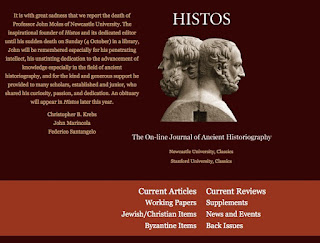
We're very sorry to hear about the passing of John Moles at Newcastle University. Brillant classics researcher; instrumental as founder and editor of Histos journal. I'll miss his friendship and our exchange of ideas regarding historiography and St. Luke's writings. He was key in helping me to explore new avenues of research. 

We extend our condolences to his family, friends and colleagues. 


Sunday, July 26, 2015

'Oldest' Koranic fragments - amazing discovery in a university library!

One of the oldest fragments of the Koran (Islam's holy book) was just waiting a hundred years to be identified as such in the library of the University of Birmingham. Further research will be conducted to verify the initial
results.

Here is what makes this find so fascinating: the parchment (sheep or goat skin) has been dated from between 568 and 645. This places the manuscript very close to the period when Mohammed claimed to receive revelations, between the years 610 and 632 A.D. The scribe may have even heard Mohammed's preaching.

I'm intrigued by what these pages might reveal of the textual history of that early (or earliest) period of the Koran. Specialists (textual critics and Islamic scholars) must be anxious to read this manuscript for themselves.

Here's more information about this discovery:

Article in English

Article in French

Pages