Showing posts with label Acts of the Apostles. Show all posts

Wednesday, July 13, 2022

Proofs of the Divine in the Acts of the Apostles and Herodotus’ Histories

Around 500 years separate Herodotus, the first great Greek historian, and Luke, the author of the Gospel of Luke and the Acts of the Apostles. In my latest journal article, I explore the word tekmêrion 'proof' or 'evidence', which they use to describe their perception of divine activity. Their theological understanding of the world was different but they did believe that there was something greater working behind the scenes and often in the scenes

Proofs of the Divine: Luke’s Use of Tekmhpion in Acts 1:3 in Light of Herodotus’ Description of the Battle of Mycale (Hist. 9.100.2)

Abstract:

In Acts 1:3, the author claims that Jesus had shown himself alive ‘by many proofs’ (ἐν πολλοῖς τεκμηρίοις). Phrases containing τεκμήριον (a NT hapax) qualified by πολύς have a long textual history. Reference works, however, do not discuss the closest rhetorical and theological parallel to the occurrence of τεκμήριον in Acts, which is found in Herodotus’ description of the battle of Mycale (Histories 9.100.2) in a metaleptic aside about proofs of divine intervention in human history: Δῆλα δὴ πολλοῖσι τεκμηρίοισι ἐστὶ τὰ θεῖα τῶν πρηγμάτων. Given the theologically charged nature of Luke–Acts and the Histories, this rich parallel illustrates well both projects and evinces plausible Herodotean influence on Luke’s historiographical erudition.

Monday, May 16, 2022

Proofs of the Divine: Luke’s Use of Tekmhpion in Acts 1:3 in Light of Herodotus’ Description of the Battle of Mycale (Hist. 9.100.2)

Happy to share my article that compares uses of tekmêrion (proof or convincing proof) by Herodotus and Luke in relation to their beliefs--which were obviously different--that the divine was at work in the scenes they describe. 

The article can be found here (if you have access): 
Proofs of the Divine: Luke’s Use of Tekmhpion in Acts 1:3 in Light of Herodotus’ Description of the Battle of Mycale (Hist. 9.100.2)

Here is the abstract:
In Acts 1:3, the author claims that Jesus had shown himself alive ‘by many proofs’ (ἐν πολλοῖς τεκμηρίοις). Phrases containing τεκμήριον (a NT hapax) qualified by πολύς have a long textual history. Reference works, however, do not discuss the closest rhetorical and theological parallel to the occurrence of τεκμήριον in Acts, which is found in Herodotus’ description of the battle of Mycale (Histories 9.100.2) in a metaleptic aside about proofs of divine intervention in human history: Δῆλα δὴ πολλοῖσι τεκμηρίοισι ἐστὶ τὰ θεῖα τῶν πρηγμάτων. Given the theologically charged nature of Luke–Acts and the Histories, this rich parallel illustrates well both projects and evinces plausible Herodotean influence on Luke’s historiographical erudition.


Thursday, May 20, 2021

Herodotus' hermeneutical dilemma, prophetic voice, and an estranged child named Luke

Here is my presentation for the research network 'Herodotus Helpline'. 

I explain my research project that shows the similarities and differences between Herodotus, known as the father of Greek history, and Luke the evangelist who wrote history in his own way, combining elements of Jewish and Greek historiography. 

Was (is) Luke estranged from Herodotus’ legacy? 
If so, then by whom?
Estranged by time, place, culture, or religion? 
Estranged by scholarship? 
Estranged by Luke himself? 

Or there is some degree of rapprochement?


To see more presentations on Herodotus Helpline

Thursday, January 2, 2020

Co-edited book on Luke-Acts and ancient historiography

We are happy to announce the publication of contributions to our international colloquium on Luke-Acts and ancient historiography, which took place at the University of Fribourg in September 2017 (see program).

Book description:
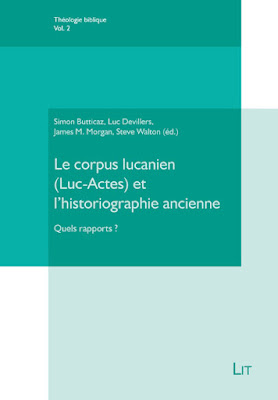
Luke-Acts and ancient historiography
English: In biblical research, consensus is rare. Formulated by Dibelius at the beginning of the 20th century, the thesis that Luke is “the first Christian historian” is one such. Among the authors of the New Testament, Luke is alone in tracing the future of the Church after Easter, composing a two-volume work (B.W. Bacon ; H.J. Cadbury). If this action is original, it does not escape influences from ancient historiography. It is to explore these links that this volume is dedicated.

French: Dans la recherche biblique, les consensus sont rares. Formulée par Dibelius au début du xxe siècle, la thèse qui fait de Luc « le premier historien chrétien » en est un. Dans le Nouveau Testament en effet, l’auteur à Théophile est le seul à retracer le devenir de l’Eglise au lendemain de Pâques, composant une œuvre en deux tomes : « Luc-Actes » (B.W. Bacon ; H.J. Cadbury). Si ce geste est original, il n’échappe toutefois pas aux influences et dépendances face aux pratiques anciennes d’écriture. C’est à explorer ces liens que se consacre le présent volume, fruit d’un colloque organisé en 2017 à Fribourg. Entre reprises et développements des modèles et pratiques littéraires de l’Antiquité, l’écriture de Luc,
l’historien, est ainsi profilée.

To order this book: go to Amazon or LIT Verlag

Abstract of my contribution:

Daniel Marguerat describes Saint Luke's writings as being at the crossroads of two historiographies, Jewish and Greek. Indeed, Luke helped to clear a new road of historiography, which is both Greek and Jewish and without any apparent complex about it. In fact, the way Luke brings these two roads together is multidimensional. One key aspect is through his representation of the divine in a fresh way that brings the two roads together in order to make sense of the past, for the interest and benefit of an international audience. This manner of writing history may be considered a subgenre, ‘prophetic historiography’, one that includes the divine from the historian’s own worldview as a central part of the narrative’s argumentation. This essay then proposes this subgenre as a research tool for exploring historians with a retrospective prophetic role in their own societies. This conceptual link is a key part of a broader writing project that explores this history-writing sans complexe as manifest in the writings of two fathers of historiography, Herodotus and Luke. In the latter part of the article, it will be suggested that Luke sought not only to imitate the tradition that Herodotus established, but also to culminate effectively Jewish and Greek historiographical traditions.
Morgan, James, "Prophetic historiography: Definition and relevance for Herodotean and Lukan research" in Le corpus lucanien (Luc-Actes) et l’historiographie ancienne : quels rapports ?, S. Butticaz, L. Devillers, J. M. Morgan et S. Walton (sous dir.), Zurich, LIT, 2019, 69–95.

Women and prophecy in Herodotus and Luke: my contribution to the Festschrift for Max Küchler


It was a pleasure to contribute a chapter to honor our colleague Max Küchler on his 75th birthday. Here's a short description of my contribution:

In the Greek historiographical tradition, Herodotus and Saint Luke stand out in a few ways from historians of their times. One way is their inclusion of women in their histories, both quantitatively and qualitatively. Another way is their substantial
inclusion of the divine sphere as a part of their descriptions of human history. Th is essay then explores the link between these two interests: women and the divine. For the limits of this contribution, the comparison will be on the narrative significance of women in relation to divine communication. Additionally, the encounter of the Pythian tradition and the Christian prophetic tradition in the Acts of the Apostles will be examined as well as later developments in early church history.

For more info:

Morgan, James M., "Marvelous Women of Prophecy in the Narrative Strategies of Herodotus’s Histories and Luke-Acts" in Sprachbilder und Bildsprache. Studien zur Kontextualisierung biblischer Texte. Festschrift für Max Küchler zum 75. Geburtstag, NTOA / StUNT 121, M. Lau, K. M. Schmidt et T. Schumacher (sous dir.), Göttingen, Vandenhoeck & Ruprecht, 2019, p. 423–455.

Pages