Showing posts with label Culture. Show all posts

Thursday, October 29, 2020

What do you do with your democracy? (Herodotus strikes again!)


Introduction


Democracy: the rule of the people; or the rule that is partially in the hands of the people. Some people are struggling for democracy right now. Some people live in a democracy but don’t fully appreciate it, because they haven’t lived under other forms of government. Others appreciate democracy but don’t know how to live it effectively.


This raises a few questions: what is the best form of government? Does it make any difference? Interestingly, these questions are actually quite ancient. 


In this video, we are going to consider a brilliant text from antiquity written by Herodotus, a Greek historian from fifth-century BCE. In this text Herodotus describes a group of Persians who are debating about three types of government: monarchy[1], oligarchy, and democracy. 


You can find the text here: Herodotus’s Histories, Book 3, chapters 80-86. 


Which one is the best for Persia? Which one did they choose? Why did it matter to Herodotus? And what does it matter to us? 


For more, please watch the video. 


Other important texts mentioned in the video: See especially Plato, Rep. 1.338e; Books 6 and 8, specifically VIII.1–VIII.5. 543a–550c. Timocracy; VIII.6–VIII.9. 550c–555b. Oligarchy; VIII.10–VIII.13. 555b–562a. Democracy; VIII.14–IX.3. 562a–576b. Tyranny.


[1] Synonyms: autocracy = a system of government by one person with absolute power. Tyranny = cruel and oppressive government or rule.

Sunday, July 26, 2015

'Oldest' Koranic fragments - amazing discovery in a university library!

One of the oldest fragments of the Koran (Islam's holy book) was just waiting a hundred years to be identified as such in the library of the University of Birmingham. Further research will be conducted to verify the initial
results.

Here is what makes this find so fascinating: the parchment (sheep or goat skin) has been dated from between 568 and 645. This places the manuscript very close to the period when Mohammed claimed to receive revelations, between the years 610 and 632 A.D. The scribe may have even heard Mohammed's preaching.

I'm intrigued by what these pages might reveal of the textual history of that early (or earliest) period of the Koran. Specialists (textual critics and Islamic scholars) must be anxious to read this manuscript for themselves.

Here's more information about this discovery:

Article in English

Article in French

Wednesday, June 17, 2015

A treat from Niger: the best peanuts in the world (in a whisky bottle)

Anyone who has lived in West Africa knows that the best peanuts are bought on the street. They are usually sold in bottles of gin or whisky (see photo). Excellent example of recycling!

Recently our daughters came back from a trip to Niamey and brought us two wonderful bottles of whisky...filled with delicious Nigerien peanuts. These were one of our favorite snacks in Niger, either roasted or caramelized.

Now, take a look at the whisky bottle itself. I've never tried this brand, and I'm not really enticed to do so either. A whisky called "Lava" doesn't seem too promising to me. The "Best Quality" on the label doesn't convince me either.

The bottle is perfect though. I'll stick to Lava's peanuts.

Monday, March 2, 2015

"iCafé Fribourg" - Proud to be a part of this adventure!


It's about time I write an entry on the "iCafé Fribourg", which was inaugurated last August (2014).
iCafé - BGS Fribourg GBU VBG

The Bible Groups for Students in Fribourg, a recognized UniFr association, opened this lovely place for university and professional school students in Fribourg. It's a place to hangout, drink various types of delicious coffee and tea, practice languages (German, French and English), attend conferences, eat scrumptious meals, etc. We're trying to keep the place open as often as possible, but we need more volunteers (iCafé is a nonprofit organization). The "iCafé" ("i" for international) means we promote cross-cultural interaction between different linguistic and cultural groups. Being officially bilingual, Fribourg is a great place to attempt to cross cultural boundaries and climb over linguistic barriers. At our last meal, raclette was served to folks from more than ten different nationalities. We talked about the funny, and not so funny, experiences we have had as foreigners in Switzerland (greetings, money, work, how to have or not have arguments, privacy and isolation, etc.). I'm looking forward to more events where we can share openly about our experiences as pilgrims in this big, often scary world and as guests in this small, beautiful country! Although I am a Swiss citizen (thanks  to my wife!), I still have a lot to learn in order to survive and thrive here!

The "iCafé Fribourg" is located in Avenue de Beauregard 3 (Canisius building), just a short walk from Fribourg's main bus/train station. 

For more info, please see the following web pages in English (international.vbg.net/fribourg), French (www.gbeu.ch/fribourg), or German (www.fribourg.vbg.net).

Tuesday, March 12, 2013

The Swiss Linguistic Landscape: Challenge and Opportunity

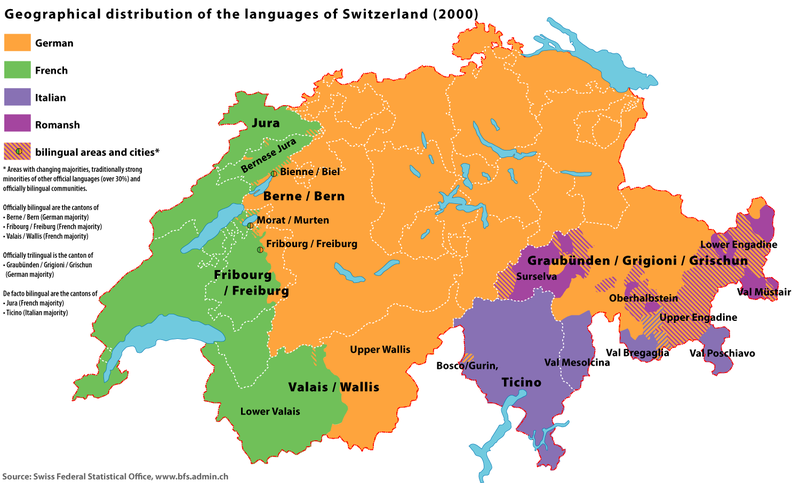
Swiss Linguistic Landscape (2000) - www.bfs.admin.ch
We live very close to the so-called "Röstigrabe" or "Barrière de Rösti," that is, the term for the linguistic border, especially between French and German-speaking populations. (Click here for a linguistic map.)

This is not to be confused with the Swiss borders with France, Germany, Austria, and Italy. That's challenging enough when you consider that Switzerland (15,940 sq mi/41,285 km2) is smaller than my home state of Virginia (42,774.2 sq mi/110,785.67 km2).

To give you an idea of this linguistic landscape, look on a Swiss map for Senèdes (where we live, hard to find!) and Giffers (where Lilian works, also hard to find!). Senèdes is a French-speaking village. There are no road signs or shops in German to help those from the other side. Lilian drives ten minutes to the east and she's in Giffers, a German-speaking village. Now, politically, Senèdes and Giffers are both in the same canton (similar to a state). Official documents are always in both languages. Kids learn German, French, and English, so they are supposed to be able to communicate well with each other. Many are bilingual, even trilingual. Swiss people grow up with visual and audible reminders that they live near "other speakers." This ranges from multilingual ingredients on food products, technical instructions, media, and public announcements like in trains. Or on a more personal level, you might meet someone who just speaks to you in their language, since you are supposed to understand it, and you have the right to answer back in your language. This happened one day when I was trying to figure out how to get a bus ticket from the vending machine on the French-speaking side of Fribourg. The bus driver noticed my perplexity and compassionately got out of the bus to help me. So, I started to speak to him in French, but he let out the ticket for me explaining the whole process in his German dialect. It worked. Sometimes this linguistic encounter can be quite simple like when you enter Fribourg (where I work), you are greeted by a bilingual sign with "Fribourg" and "Freiburg." Not too hard to figure that out. Yet, if it were only that easy...the difference in place names can be so drastic as "Düdingen" (in German) and "Guin" (in French)!

Besides these obvious differences between languages, a few things complicate real communication. First, on the German-speaking side, they also speak dialects. So, you can imagine how the French-speaking population feel...they learn standard German in school and not one of the Swiss German dialects (because there are in fact many Swiss German dialects!). This problem can be overcome by the fact that French speakers can just speak standard German, because the German dialect speakers know standard German well...or at least they should...You see they are very proud of their own language and in general don't really like to speak standard German. Ugh. You see how it's complicated...and this leads to the next challenge or opportunity, namely, the use of English!

Second, these days most Swiss youth like to learn and speak English. This is true on both sides of the linguistic border. So, what often happens is that when young people from German and French-speaking sides meet, they often choose English as their common language. It works quite well when both parties feel comfortable expressing themselves in English. This happens in private conversation, but even in university classrooms and research centers. At the University of Fribourg/Freiburg, I constantly here German, Swiss German, French, Italian, and English. Sometimes you can hear people switch from one  language to another in mid-sentence.

So, for English speakers, this means it is fairly easy to mix with Swiss people, right? Yes and no. Yes, with the younger folks, but much less with the older generations. Also, English can only get you so far socially, since it isn't reasonable to expect an entire group (class, family, club, etc.) to switch to English just because you are there. Swiss are hospitable...but let them be Swiss, please. There simply has to be an agreement when English is necessary to allow communication to happen or to get the job done.

Now, you might be wondering what this "Rösti" is all about. It is a Swiss dish like "hashed potatoes," which represents one of those national myths that Rösti is a defining factor between the regions, that is, that the Swiss Germans actually eat more Rösti than their French-speaking compatriots! In fact, people on both sides enjoy this dish and there are different competing recipes for it. So, if you want to eat well, come to Switzerland (there's more than just Rösti!), but even more so, come to Switzerland if you want to experience a linguistic challenge or opportunity!

Salut, Tschüss, Ciao, Bye!

Pages