Showing posts with label Theology. Show all posts

Wednesday, April 19, 2023

From being a player to an artist in the humanities?


Like so many creative activities, learning to become an artist lies in thousands of small decisions and executions, which Marty demonstrates here. 

I think there are many parallels with writing in the humanities including theology, historical research, narratology, etc. Some good food for thought!

https://youtube.com/clip/UgkxPaTPiHVGfs9J-suAAyyK93h8gnqNLRKT

Monday, May 16, 2022

Proofs of the Divine: Luke’s Use of Tekmhpion in Acts 1:3 in Light of Herodotus’ Description of the Battle of Mycale (Hist. 9.100.2)

Happy to share my article that compares uses of tekmêrion (proof or convincing proof) by Herodotus and Luke in relation to their beliefs--which were obviously different--that the divine was at work in the scenes they describe. 

The article can be found here (if you have access): 
Proofs of the Divine: Luke’s Use of Tekmhpion in Acts 1:3 in Light of Herodotus’ Description of the Battle of Mycale (Hist. 9.100.2): 

Here is the abstract:
In Acts 1:3, the author claims that Jesus had shown himself alive ‘by many proofs’ (ἐν πολλοῖς τεκμηρίοις). Phrases containing τεκμήριον (a NT hapax) qualified by πολύς have a long textual history. Reference works, however, do not discuss the closest rhetorical and theological parallel to the occurrence of τεκμήριον in Acts, which is found in Herodotus’ description of the battle of Mycale (Histories 9.100.2) in a metaleptic aside about proofs of divine intervention in human history: Δῆλα δὴ πολλοῖσι τεκμηρίοισι ἐστὶ τὰ θεῖα τῶν πρηγμάτων. Given the theologically charged nature of Luke–Acts and the Histories, this rich parallel illustrates well both projects and evinces plausible Herodotean influence on Luke’s historiographical erudition.


Sunday, July 26, 2015

'Oldest' Koranic fragments - amazing discovery in a university library!

One of the oldest fragments of the Koran (Islam's holy book) was just waiting a hundred years to be identified as such in the library of the University of Birmingham. Further research will be conducted to verify the initial
results.

Here is what makes this find so fascinating: the parchment (sheep or goat skin) has been dated from between 568 and 645. This places the manuscript very close to the period when Mohammed claimed to receive revelations, between the years 610 and 632 A.D. The scribe may have even heard Mohammed's preaching.

I'm intrigued by what these pages might reveal of the textual history of that early (or earliest) period of the Koran. Specialists (textual critics and Islamic scholars) must be anxious to read this manuscript for themselves.

Here's more information about this discovery:

Article in English

Article in French

Saturday, July 12, 2014

N.T. Wright's conference - 10-13 June 2014 - University of Fribourg

The Center for Faith and Society (site in German, part of the Institut for Ecumenical Studies, UniFr) organized their first-ever conference by inviting N.T. Wright, biblical scholar and former Anglican bishop. Not bad for a start! Almost four hundred participated in this four-day event. Congratulations to the team for putting this event together. People from various Christian traditions and theological persuasions attended and...it all happened very peacefully ;-)

L to R: N.T. Wright, Ulrich Luz, Markus Lau, James Morgan
I had a small but enjoyable part in this event. I gave the devotional on Monday morning, then I helped to lead the Question and Answer session on Wednesday afternoon with my colleague Markus Lau (see picture). It was good to explore Wright's thoughts on Paul as a Jewish thinker whose mind and heart were transformed through his encounter(s) with the risen Christ and the Holy Spirit.

With my keen interest in Luke's writings (Luke and Acts), Wright's lectures helped me again to imagine what Paul encountered (with his missionary team) as "the apostle to the nations" and how he responded to genuine pastoral concerns through his convictions as a "Messianic Jew." Wright's lectures were mostly based on his recent books: "Paul and the Faithfulness of God" (Part IV in "Christian Origins and the Question of God").

Saturday, June 14, 2014

Ivory Coast comes to Fribourg

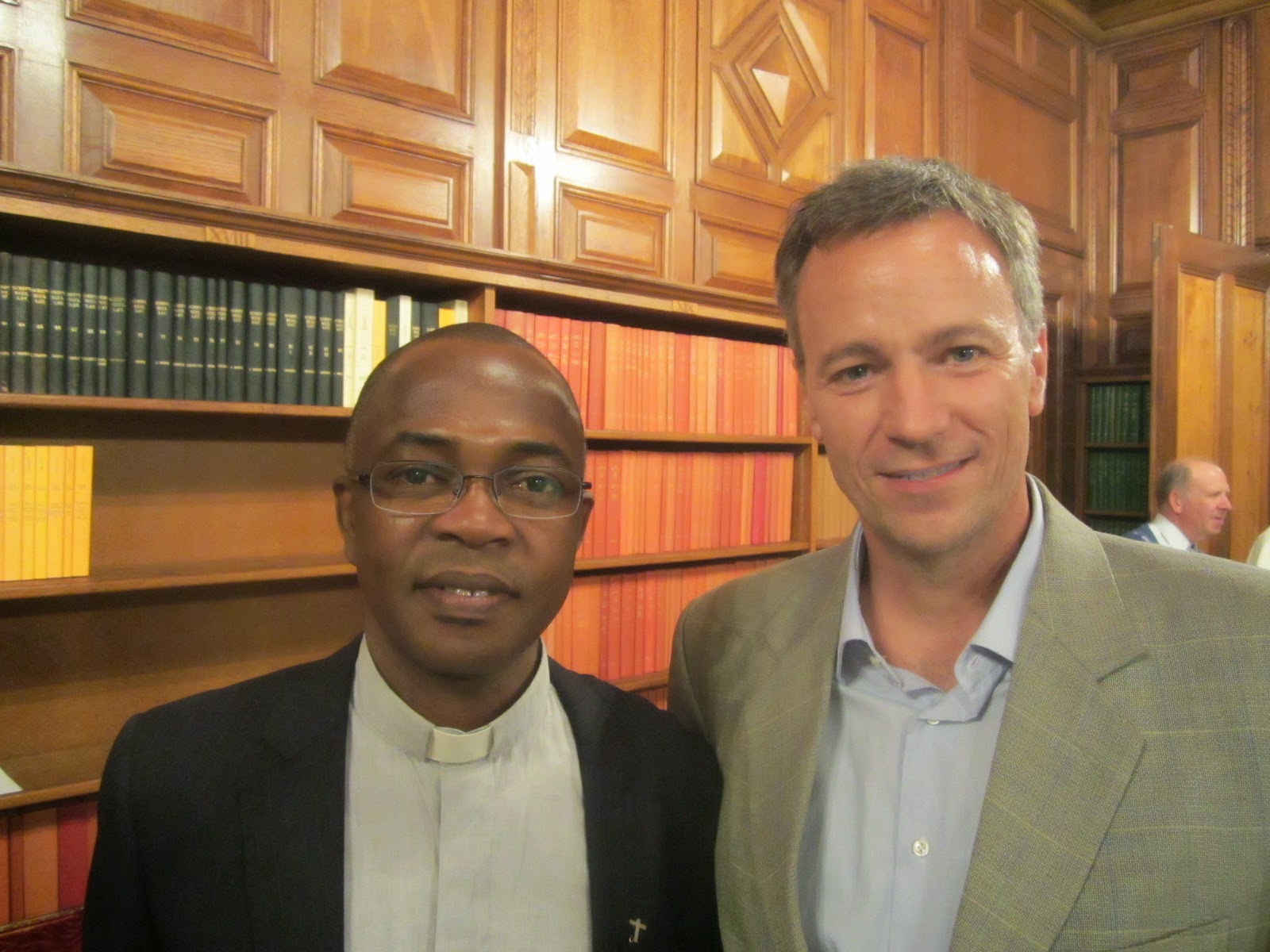
Drs. Appoh François Kouamé and James Morgan
One of the benefits of living in Fribourg and working at the University is to be a part of an international community. In the hallways and classrooms you hear many languages and accents. Since I spent almost ten years in Niger, it is a pleasure for me to have colleagues and students from Africa: Rwanda, Ethiopia, Eritrea, Cameroun, Benin, etc.

In my first participation in the jury of a doctoral defense here, I was really glad that the candidate was from Ivory Coast. It was a touch of grace and made me feel at home in front of the audience in that academic atmosphere. Appoh François Kouamé wrote about a subject that is very close to his heart as pastor and teacher: the notion of blood brothers and brothers in Christ (the dissertation title, De "frères de sang" à "frères en Christ". L’appel des premiers disciples : prolégomènes à l’herméneutique de la fraternité spirituelle). In general, the question of brotherhood in Africa is more keenly felt in families and churches than in western culture. It can help or hinder spiritual unity in African churches. Kouamé explores this question by beginning with an analysis of passages in the Bible regarding brothers and then focuses on the two sets of brothers that Jesus chose as his disciples. If you are interested in this topic, you can find it here (in the collection of e-theses at UniFr).

Pages